

Categories
The Ultimate Guide to Footwear Safety Codes & Ratings
Safety footwear codes are standardised markings — such as EN ISO 20345, the S1–S7 safety classes, slip-resistance codes and additional letter markings — that tell you exactly what protection a boot has been tested for, rather than relying on the product name.
That makes them far more useful than looks or comfort alone when you’re choosing footwear for your team, since they show whether a pair is actually suitable for the job.
The main safety footwear codes you’ll come across are:
- EN ISO 20345: the main safety footwear standard, including toe protection tested to withstand a 200-joule impact.
- SB to S7 ratings: classes covering different combinations of protection, including penetration resistance and water resistance.
- Slip-resistance markings: these changed with EN ISO 20345:2022, but older SRA, SRB and SRC codes are still around and shouldn’t be confused with the current system.
- Additional letter codes: markings for specific properties such as antistatic footwear, heat-resistant outsoles or metatarsal protection.
Once you know how to read them, safety boot ratings are fairly straightforward. This guide covers the current EN ISO 20345:2022 system, and explains the older markings you’re still likely to come across when comparing safety footwear codes.
What Are the UK Safety Footwear Regulations?
Under the Personal Protective Equipment at Work Regulations, UK employers must provide suitable safety footwear free of charge wherever a workplace risk assessment identifies a foot-injury hazard that can’t be controlled another way. The key word here is suitable: issuing one standard pair of safety boots across a workforce isn’t enough if people are exposed to different hazards.
EN ISO 20345 is the standard to look for when protective toe caps are required. Footwear certified to the standard has toe protection tested against a 200-joule impact (or 20kg object falling from about one metre), along with the other applicable requirements of the standard. Occupational footwear covered by EN ISO 20347 is different because it doesn’t have the same 200J protective toe-cap requirement.
Depending on the footwear, the safety footwear codes identify protection against hazards such as penetration through the sole or water exposure. That’s why we’d always recommend starting with the workplace risk assessment and then checking the rating against the risks identified, rather than choosing a boot simply because it’s described as a safety boot.
If you’re also reviewing clothing for your workforce, our guide to whether uniforms are considered PPE explains where everyday workwear ends and PPE begins.
Case Study: From Two Jackets to a Full Team Rollout: Kitting Out Graham Heath Construction
Understanding EN ISO 20345: What Does the Standard Mean?
EN ISO 20345 is the main European standard for safety footwear. It requires every certified boot or shoe to have a protective toe cap tested against a 200-joule impact, then uses additional codes to show what else the footwear has been tested for.
- EN refers to a European Norm.
- ISO is the International Organization for Standardization.
- 20345 is the number assigned to this particular standard.
For anyone buying work boots, the useful part is what comes after that number. That’s where ratings such as S1 or S3S and markings such as HRO or WR come in, each one telling you a specific protection the footwear has been tested for.
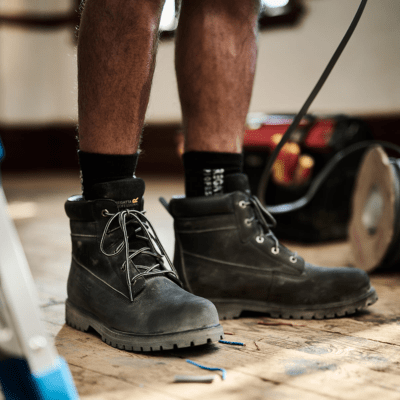
What Does 200-Joule Toe Protection Mean?
A joule is a measure of energy, and the 200J figure refers to the impact energy used when the toe cap is tested under controlled conditions. Roughly a 20kg object dropped from about one meter, without collapsing onto the toes.
It’s best treated as a recognised testing benchmark rather than a promise that the boot can protect against every real-world 200J impact. What happens on site will depend on the circumstances, which is another reason the footwear still needs to be chosen around the actual risks of the job.
EN ISO 20345:2011 vs EN ISO 20345:2022
The standard was revised in 2022, and this is where safety footwear codes can get confusing. Older stock and product information may still use terminology from EN ISO 20345:2011, whereas newer footwear can carry codes introduced by the 2022 revision.
| EN ISO 20345:2011 | EN ISO 20345:2022 |
| SRA, SRB and SRC slip ratings | Slip resistance included in the basic requirements, with additional SR testing |
| WRU marking | WPA marking |
| Penetration resistance primarily identified by P | P, PL and PS distinguish different types of penetration-resistant inserts and tests |
| Classes ran from SB to S5 | S6 and S7 classes added |
This is worth checking when you’re comparing two apparently similar pairs of boots. An older SRC marking, for instance, isn’t directly interchangeable with the current SR marking; they’re based on different versions of the standard.
How to Read a Safety Footwear Code
You read a safety footwear code left to right: the standard and its year first, then the main safety class, then any additional protection markings.
Let’s take EN ISO 20345:2022 S3S FO SR as an example:
- The first part tells you the standard and revision the footwear has been tested against.
- S3S is the main safety class, with the final S identifying the PS penetration-resistance test.
- FO means the outsole has been tested for resistance to fuel oil.
- SR identifies additional slip-resistance testing.
Reading the full safety footwear code matters. Two boots described as “S3 safety boots” can have different additional markings, and those differences may be exactly what determines which pair is appropriate for your particular workplace.
Safety Boot Ratings Explained: SB to S7
SB to S7 are the safety classes defined by EN ISO 20345. Each one is a set combination of protective features rather than a simple scale from worst to best, so the right class is the one that matches the hazards of the job. Rather than treating SB through to S7 as a simple scale, think of each class as a defined combination of protective features. The right rating is the one that covers the risks of the job.
The 2022 standard also introduced more detail around penetration resistance. Alongside familiar ratings such as S1P and S3, you can now see classifications including S1PL, S1PS, S3L and S3S, depending on the type of penetration-resistant insert and how it has been tested.
| Rating | What protection does it provide? | Water protection | Penetration protection | Typical use |
| SB | Basic EN ISO 20345 safety requirements, including a 200J toe cap | No additional water requirement | No | Basic workplace protection where additional features aren’t required |
| S1 | SB + closed heel, antistatic properties and heel energy absorption | No | No | Dry indoor workplaces |
| S1P / S1PL / S1PS | S1 + penetration-resistant insert | No | Yes – P, PL or PS depending on insert/test | Dry workplaces with sharp-object risks underfoot |
| S2 | S1 + water penetration and absorption resistance of the upper (WPA) | Water-resistant upper | No | Work where occasional water exposure is expected |
| S3 / S3L / S3S | S2 + penetration resistance + cleated outsole | Water-resistant upper | Yes – P, PL or PS | Construction, outdoor work and environments with underfoot hazards |
| S4 | Class II rubber/polymeric footwear with closed heel, antistatic properties and heel energy absorption | Moulded rubber/polymeric construction | No | Wet working environments |
| S5 / S5L / S5S | S4 + penetration resistance + cleated outsole | Moulded rubber/polymeric construction | Yes – P, PL or PS | Wet or muddy environments with underfoot hazards |
| S6 | S2 + whole-footwear water resistance (WR) | Whole-footwear water resistance | No | Prolonged outdoor or wet working conditions |
| S7 / S7L / S7S | S3/S3L/S3S + whole-footwear water resistance | Whole-footwear water resistance | Yes – P, PL or PS | Wet outdoor work where penetration resistance is also needed |
P refers to a metallic penetration-resistant insert tested with a 4.5 mm nail. PL is used for a non-metallic insert tested with a 4.5 mm nail, while PS identifies a non-metallic insert tested with a smaller 3 mm nail.
You’ll also notice that S4 and S5 are different from the usual leather or textile safety boots. These classifications apply to Class II footwear made entirely from rubber or polymeric materials, which is why they’re commonly associated with safety wellingtons.
S6 and S7 are newer additions. Both introduce WR whole-footwear water resistance. S6 builds on S2, whereas S7 builds on the penetration-resistant S3 requirements. That’s a meaningful difference if you’re specifying safety footwear codes for people spending long periods outside rather than occasionally encountering a wet floor in a warehouse.
Does a Higher Safety Boot Rating Mean Better Protection?
An S7 work boot has more specified protective properties than an S1 boot, but those extra features don’t automatically make it the better choice for every worker.
If someone spends every shift in a dry indoor environment, whole-footwear water resistance offers very little practical benefit. What matters is whether the safety footwear code matches the hazards identified in the risk assessment. That’s a much better way to specify footwear than simply working your way towards the highest number.
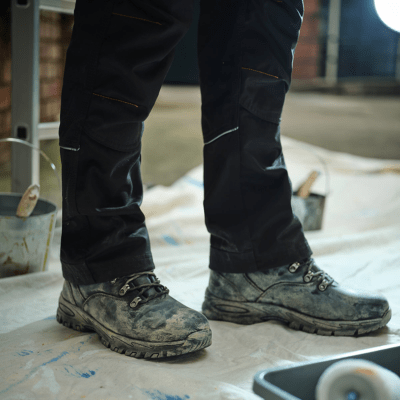
Slip Resistance Ratings Explained
Slip resistance is one of the safety footwear codes where checking the version of the standard really matters. You’ll still see SRA, SRB and SRC used on older footwear and across plenty of product pages, but these belong to EN ISO 20345:2011. The system changed with EN ISO 20345:2022.
Under the current standard, most safety footwear has to meet a basic slip-resistance requirement, so there isn’t a separate code to show that it has passed this test. The test uses ceramic tile with a sodium lauryl sulphate solution.
Footwear carrying the SR code marking has also passed the optional slip-resistance test on ceramic tile with glycerol. It’s not simply a new name for SRC; the test method has changed too.
| Marking | Standard | What does it mean? |
| No additional marking | EN ISO 20345:2022 | Footwear meets the standard’s basic slip-resistance requirement |
| SR | EN ISO 20345:2022 | Footwear has passed the additional slip-resistance test using glycerol on ceramic tile |
| SRA | EN ISO 20345:2011 | Tested on ceramic tile with a detergent solution |
| SRB | EN ISO 20345:2011 | Tested on steel with glycerol |
| SRC | EN ISO 20345:2011 | Met both the SRA and SRB requirements |
You may also see the Ø symbol where the standard’s slip test can’t be applied to a particular design, such as some footwear fitted with spikes. That isn’t another slip rating, it just tells you there’s an exception to the normal requirement.
What Happened to SRA, SRB and SRC Safety Boot Ratings?
If you’re familiar with SRC safety boots, there’s no need to assume that a current pair without SRC has somehow lost its slip protection. SRC was part of the previous testing system and won’t appear as the current slip marking on safety footwear certified to EN ISO 20345:2022.
When comparing products, check the year of the standard before comparing the letters. An SRC marking against the 2011 standard and an SR marking against the 2022 standard don’t mean the same thing, so treating one as the direct replacement for the other can be misleading.
This is more than a technical detail on a footwear label. HSE identifies slips and trips as the most common cause of workplace injury, so the surfaces people actually work on need to be considered when you’re thinking about footwear safety codes. A slip-resistance code is useful evidence of how the outsole has performed under a standardised test, but it doesn’t replace dealing with contamination or other slip hazards in your workplace.
Safety Footwear Codes and Markings Explained
The S rating gives you the main classification, but it won’t always tell you everything you need to know about a pair of safety boots. Additional safety footwear codes show where the footwear has been tested for a particular type of protection. If your risk assessment identifies a specific hazard, these letters are where you’ll find the detail you need.
| Code | What does it mean? |
| P | Penetration resistance using a metallic insert, tested with a 4.5 mm nail |
| PL | Penetration resistance using a non-metallic insert, tested with a 4.5 mm nail |
| PS | Penetration resistance using a non-metallic insert, tested with a 3 mm nail |
| A | Antistatic footwear |
| AN | Ankle protection |
| C | Conductive footwear |
| CI | Cold insulation of the sole |
| CR | Cut resistance of the upper |
| E | Energy absorption in the heel area |
| FO | Resistance of the outsole to fuel oil |
| HI | Heat insulation of the sole |
| HRO | Outsole resistance to hot contact |
| LG | Ladder grip |
| M | Metatarsal protection |
| WPA | Water penetration and absorption resistance of the upper |
| WR | Water resistance of the whole footwear |
| SC | Scuff-cap abrasion resistance |
| WRU | Older marking for water resistance of the upper, replaced by WPA under EN ISO 20345:2022 |
A couple of distinctions in that table are particularly useful when you’re comparing products:
- WPA and WR don’t mean the same thing. WPA relates to how the upper performs against water penetration and absorption, while WR applies to the footwear as a whole. If someone spends much of the working day outside in wet conditions, don’t assume a WPA marking offers the same protection as WR footwear.
- P, PL and PS identify different types of penetration resistance. P is used for a metallic insert, while PL and PS apply to non-metallic inserts. PS is tested with a smaller nail than PL, which is why you’ll now see ratings such as S3L and S3S on some footwear certified to the 2022 standard.
- Some of the terminology changed with the 2022 revision. WPA replaced the older WRU terminology, and LG for ladder grip and SC for scuff-cap abrasion resistance were introduced. It’s another reason to check the full certification marking rather than relying on a familiar code from an older pair of boots.
Types of Safety Footwear
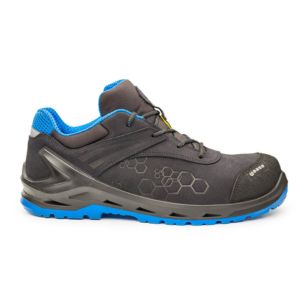
Once you’ve established the protection you need from the safety footwear codes, you can think about which style of footwear makes sense for the job. Boots aren’t automatically the best option simply because they look more heavy-duty. Someone walking around a warehouse for most of the day may be better served by a lighter safety trainer, whereas a worker spending hours outside on rough ground is going to have different priorities.
| Style | Best suited to | What to consider |
| Safety boots | Construction, trades and outdoor work | More coverage around the ankle, but usually heavier than low-cut footwear |
| Safety shoes | Warehouses, factories and indoor workplaces | Lighter and less restrictive, with less coverage around the ankle |
| Safety trainers | Active roles involving lots of walking and movement | Trainer-style comfort, but the safety rating still needs to match the hazards |
| Safety wellingtons and pull-on boots | Agriculture, wet environments and muddy sites | Easy to clean and practical in wet conditions; check the specific water and penetration protection provided |
For team orders, think about what employees are actually doing for eight hours. Weight becomes noticeable over a long shift, as can a boot that’s too warm for an indoor environment. Equally, choosing a lightweight shoe for somebody regularly working outside may be a false economy if it isn’t suited to the conditions.
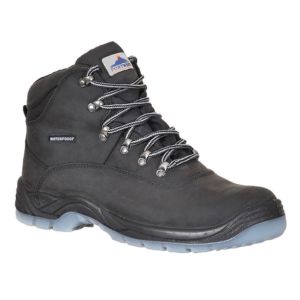
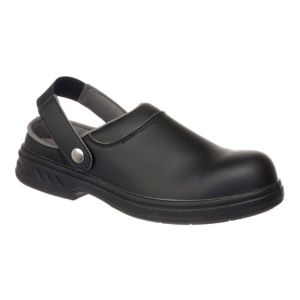
Lace-Up, Zip-Side or Pull-On?
Fastening is partly personal preference, but there are practical differences:
- Lace-up footwear gives the wearer more control over the fit.
- A side zip makes getting boots on and off quicker without losing that adjustment.
- Pull-on designs are convenient in jobs where footwear is removed regularly.
Whatever you choose, the footwear needs to stay secure during the work itself. If there’s excessive heel movement when somebody walks or climbs, we’d look at the fit rather than assuming that’s just how the boot is supposed to feel.
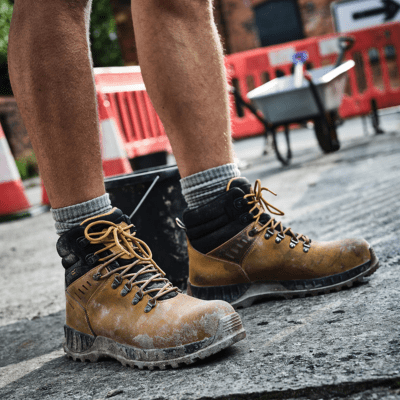
Steel vs Composite Toe Caps
The choice between steel and composite toe caps gets more attention than it needs to. Both provide compliant toe protection when they’re used in safety footwear certified to EN ISO 20345, so composite shouldn’t automatically be read as “better” or steel as “stronger”.
Steel toe caps tend to be slimmer and are often the lower-cost option. Composite toe caps contain no metal and can reduce weight, which is useful for employees spending a lot of time on their feet. Metal-free construction can also make sense in workplaces where staff regularly pass through metal detectors.
When you’re comparing composite toe safety footwear with steel toe alternatives, we’d look at the complete safety rating first. Toe-cap material is one part of the specification; the footwear still needs to provide the protection the role calls for.
Choosing the Right Safety Footwear for Your Industry
We never recommend choosing safety footwear by industry alone. Saying that construction workers need S3 boots or warehouse staff need S1 footwear is convenient, but it misses the point of the rating system. The right starting point is the hazards someone actually encounters during their working day.
Start With the Hazards, Not the Rating
Before comparing S1, S3 or any other safety footwear codes, think about what they actually need to protect against:
- Could heavy objects fall onto the feet?
- Are there nails, metal offcuts or other sharp objects that could penetrate the sole?
- Will the footwear regularly be exposed to water, mud or wet ground?
- Are workers likely to encounter slippery or contaminated floors?
- Are there specific risks involving heat, cold weather, cuts or the metatarsal area?
- Does the job involve long periods of walking or standing, climbing ladders, kneeling or working on uneven ground?
From Our Experts
“Don’t start with an S1, S2 or S3 rating and work backwards. Start with the hazards your team actually faces day to day, then look for footwear carrying the protection those roles require.” – Louis Georgiou, Operations Director
Someone walking several miles around a distribution centre has different demands from a tradesperson regularly climbing ladders and kneeling. Those practical details should influence the style you choose once you’ve established the protection required.
Case Study: Branded Workwear & PPE To Best Serve JCA Engineering
Typical Safety Footwear by Industry
These are useful starting points rather than fixed recommendations. Individual workplaces and roles can require something entirely different, and we’d be happy to give you our expert advice if you’re stuck.
| Industry | Typical rating to consider | Features worth considering |
| Construction | S3/S3L/S3S or above where appropriate | Penetration resistance, suitable slip performance, water protection and secure fit for uneven ground |
| Warehousing and logistics | S1 or penetration-resistant S1 variants; S3 where the hazards require it | Comfort for long shifts, antistatic properties and suitable slip performance |
| Agriculture | S4/S5 variants or other suitably water-resistant footwear | Water resistance, penetration protection where required, grip and easy-clean construction |
| Manufacturing | S1/S3 variants depending on the environment | HRO, HI, metatarsal or other task-specific protection where identified |
| Utilities | Depends heavily on the individual role | Water, penetration and thermal protection plus any specialist protection required for the work |
If there’s a realistic chance of stepping on nails or sharp debris, you’ll want to look specifically at penetration resistance, not just whether the product is sold as a construction boot. Regular outdoor work may make its water protection relevant as well.
Warehouses can be quite different. For somebody spending a full shift picking orders on a dry floor, a lighter S1 safety shoe or trainer may be more practical than a heavy outdoor boot, provided it covers the risks identified on site. If there is a penetration hazard, that changes the specification.
Manufacturing and utilities are harder to generalise because the work can vary so much from one site to another. This is where additional safety footwear codes such as HRO for hot-contact outsole resistance or M for metatarsal protection become useful. The main S rating won’t necessarily tell you everything you need to know.
For larger team orders, we’d use the industry as a starting point, then narrow the footwear down by role. It avoids paying for protection people don’t need while making sure the people who do face additional hazards aren’t missed.
Getting the Right Safety Footwear Fit
With safety footwear, getting the size right isn’t always as simple as ordering whatever you normally wear. The protective toe cap creates a fixed space at the front of the shoe or boot, and different designs can feel noticeably different even when the size on the box is the same.
If your toes are pressing against the cap, going up a size isn’t necessarily the best fix. The problem could be the width or shape of the toe box instead. Equally, too much room can leave the heel moving around inside the boot, which quickly becomes uncomfortable when you’re walking all day.
From Our Experts
“Safety footwear can have all the right markings and still be a poor choice for your team if it’s uncomfortable over a full stressful shift. Protection comes first, but fit and the way people actually work in the footwear matter more than managers take into account.” – Louis Georgiou, Operations Director.
We encourage our clients to try footwear with their usual work socks where possible. Feet can swell during a shift, so trying boots later in the day can also give you a better idea of how they’ll feel after several hours. If one foot is slightly larger than the other, fit to the larger foot.
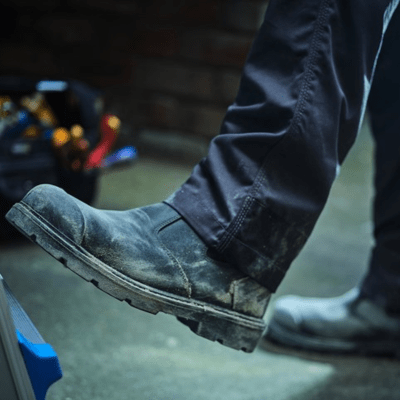
How to Check Your Safety Footwear Fits Properly
A well-fitting pair should feel secure without pinching. Before deciding on a size, walk around in the footwear and check that:
- Your toes aren’t pressing against the protective toe cap.
- Your heel isn’t lifting excessively as you walk.
- There’s no obvious rubbing or concentrated pressure.
- The footwear stays secure when you crouch or climb.
- You can move naturally without your foot sliding around inside.
Don’t rely on the idea that an uncomfortable pair of safety boots just needs “breaking in”. Materials may soften with wear, but a toe cap that’s pressing against your foot isn’t going to change shape. If there’s obvious discomfort when you try the footwear on, we’d look at another size, width or design rather than hoping it disappears after a week on site.
How you put the footwear on matters as well. Loosen lace-up boots properly instead of forcing your heel into them while they’re still tightly fastened. It takes a few seconds longer, but avoids repeatedly crushing the back of the boot and gives you a much better chance of getting the fit right each time you wear them.
Common Mistakes When Buying Safety Footwear
Here are some of the mistakes we’ve seen businesses make when specifying footwear for a workforce.
Buying Second-Hand Safety Footwear
We never recommend buying safety footwear second-hand. You have no reliable way of knowing whether it’s taken a significant impact or how heavily it’s been used. Damage to protective components isn’t necessarily visible from the outside either.
For everyday shoes, buying used might simply be a question of condition. With PPE, you’re relying on the footwear to provide a known level of protection, so that uncertainty matters.
Assuming More Expensive Means Safer
Price and protection aren’t the same thing. A more expensive boot might offer better materials or a more comfortable fit, but the price tag doesn’t tell you which safety requirements it has been tested against. Use the EN ISO 20345 rating and additional safety footwear codes for that. Once you’ve narrowed the choice down to footwear that meets the required specification, factors such as comfort and durability can help you decide where spending more is worthwhile.
Choosing the Highest Rating You Can Find
It’s tempting to think S7 must be better than S3 because the number is higher. As we’ve covered, that’s not really how safety boot ratings work. Extra protection only has value when it’s relevant to the job. Whole-footwear water resistance makes sense for somebody spending hours in wet conditions, but it’s pretty useless for a worker who never leaves a dry warehouse. Specify against the risks rather than buying the highest classification as a catch-all.
Skipping the Workplace Risk Assessment
This is where blanket footwear policies can cause problems. Two employees on the same site can encounter quite different hazards, so giving everyone the same boot doesn’t necessarily mean everyone has suitable protection.
Use the risk assessment to establish what the footwear needs to do, then look for the safety footwear codes that match those requirements for each individual employee or role.
Getting the Size or Style Wrong
A boot can have exactly the right certification and still be a poor choice if the wearer can’t get comfortable in it. Pay attention to width and toe-box shape rather than relying entirely on someone’s usual shoe size.
This becomes particularly noticeable with people who spend most of the shift walking or standing. If the footwear rubs from day one, ordering the same model again because “it’s the company boot” isn’t going to solve the problem.
Prioritising Appearance Over Suitability
There’s no reason safety footwear has to look clunky, and having a choice of styles can make it easier to find something employees are happy to wear. The order of decisions still matters, though.
Start with the protection required for the role. Then find the most comfortable and appropriate style from the footwear that meets that specification.
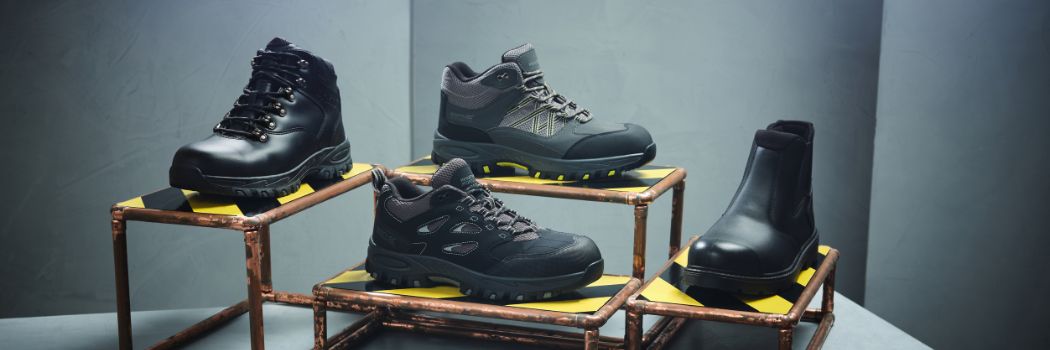
How to Care for Safety Footwear
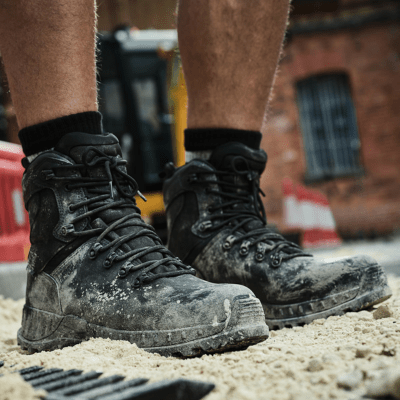
Caring for safety footwear mainly means cleaning off mud before it builds up, drying wet boots naturally rather than on a radiator, treating leather with a suitable care product, and checking laces and wear points regularly.
Safety boots don’t need complicated maintenance, but how they’re treated between shifts can make a real difference to how quickly they wear out. One of the biggest things to avoid with your workwear maintenance is trying to dry your wet footwear too quickly. Putting boots against a radiator or another strong heat source can damage the upper or adhesives, so open them up and let them dry naturally instead. If smell is a concern, a sanitising spray works better than direct heat.
Mud and dirt are easier to deal with before they’ve been left to build up. For leather footwear, use a care product that’s suitable for the material. While you’re cleaning the boots, take the opportunity to look at the areas that tend to show wear first, including the tread and where the upper joins the sole.
Laces deserve a quick check too. Replace them if they’re badly worn, and loosen lace-up boots properly when taking them off rather than forcing your heel out. Repeatedly crushing the back of a boot isn’t going to do its shape or fit any favours.
When Should Safety Footwear Be Replaced?
There’s no legal replacement interval for safety footwear. A boot worn occasionally in a clean warehouse won’t age at the same rate as one spending five days a week on a wet construction site, so we’d be wary of any blanket advice to replace every pair after a set number of months.
Instead, look at the condition of the footwear. We’d consider replacement when you find:
- Tread that’s heavily worn.
- Cracking or separation around the sole.
- Damage to the upper or seams.
- An exposed or visibly damaged toe cap.
- Damage following a significant impact.
- Fastenings that no longer hold the footwear securely.
- Loss of a protective property the role relies on, such as water resistance.
Don’t judge a safety boot solely by whether the toe cap is intact. The protection covered by its safety footwear rating can depend on other parts of the boot too. If the sole is badly worn or the upper has failed, you shouldn’t assume it’s still performing as it did when it was certified and new.
For anything less obvious, check the manufacturer’s care and replacement guidance. That’s more useful than trying to put an arbitrary lifespan on every pair of safety boots.
Find the Right Safety Footwear for Your Team with Essential Workwear
Once you know which safety footwear codes and ratings your team needs, finding the right pair becomes much easier. At Essential Workwear, we supply safety boots, trainers and shoes for a wide range of working environments, with options to suit different roles across your workforce.
Browse our safety footwear range to compare your options, or speak to our team if you’re not sure which rating is right for the job. We can also help with larger team orders and corporate accounts, making it easier to manage safety footwear alongside your wider workwear and PPE requirements!
Safety Footwear Codes FAQs
What is the difference between S1 and S3 safety boots?
S3 safety boots include additional protection that you don’t get with S1, notably resistance to water penetration and absorption through the upper, penetration resistance and a cleated outsole. S1 footwear is commonly suited to dry indoor environments where those extra requirements aren’t needed. Under EN ISO 20345:2022, you may also see S3, S3L or S3S. The suffix tells you which type of penetration-resistant insert and test applies, so it’s worth checking the full rating rather than stopping at the S3 part.
What does SRC mean on safety boots?
SRC is a slip-resistance rating from the older EN ISO 20345:2011 standard. It showed that the footwear had met both the SRA and SRB slip-resistance requirements. Under EN ISO 20345:2022, slip resistance forms part of the basic requirements for most footwear, with SR identifying additional slip testing. SR isn’t simply a new name for SRC, as the test requirements changed with the standard.
Can safety footwear be worn outdoors, and which rating do I need?
Safety footwear can certainly be used outdoors, but there’s no single rating we’d recommend for every outdoor job. A grounds worker spending hours on wet grass has different requirements from someone who only crosses a yard between buildings. Look at how much exposure there is to water and whether there’s a penetration risk from sharp objects underfoot. From there, you can narrow the choice down using the relevant safety boot ratings and additional markings.
How often should safety footwear be replaced?
Safety footwear should be replaced when wear or damage means you can no longer rely on it to provide the required protection. There isn’t a standard replacement period that works for every pair. Check the footwear regularly and pay attention to deteriorating tread or sole separation. Damage following a significant impact is another reason to reassess a pair even if it hasn’t been in use for very long.
What is the difference between EN ISO 20345 and EN ISO 20347?
The main difference is the toe protection. EN ISO 20345 covers safety footwear with a protective toe cap tested to the standard’s 200-joule impact requirement. EN ISO 20347 covers occupational footwear without that 200J safety toe-cap requirement. That doesn’t make EN ISO 20347 footwear unsuitable for work. It’s intended for roles where occupational footwear is appropriate but safety toe protection isn’t required. Your risk assessment should tell you which type you need.
What is the difference between steel and composite toe caps?
Both steel and composite toe caps can meet the requirements of EN ISO 20345 when used in correctly certified footwear. The material itself isn’t a safety rating. Steel toe caps are often slimmer and can be less expensive. Composite caps are metal-free and may reduce the weight of the footwear, making them useful where employees spend long periods walking or regularly pass through metal detectors. We’d choose between them after establishing the required safety footwear codes, rather than assuming that composite or steel automatically offers better protection.
Does a higher safety boot rating mean it is safer?
A higher safety boot rating doesn’t automatically make a boot safer for a particular job. The S classes identify different combinations of protective properties rather than acting as a simple safety score. For example, an S7 boot includes whole-footwear water resistance and penetration protection. Match the specification to the risk assessment.
Where can I find the safety rating on my work boots?
Look for the identification marking on the footwear, commonly found on the label inside the boot or tongue. The manufacturer’s product information should also state the applicable standard and classification. A current marking might look something like EN ISO 20345:2022 S3S FO SR. Checking the complete code tells you which version of the standard applies and whether the footwear carries additional protective markings.
What does S3S mean on safety boots?
S3S is an S3 safety boot certified to EN ISO 20345:2022, where the final S shows the penetration-resistant insert is non-metallic and has been tested with a smaller 3 mm nail (the PS test). It provides the same core S3 protection — a water-resistant upper, penetration resistance and a cleated outsole — with that specific type of insert. You may also see S3L, which uses a non-metallic insert tested with a 4.5 mm nail.
Is S3 safety footwear waterproof?
Not fully. S3 footwear has a water-resistant upper (the WPA test), which resists water penetrating and being absorbed through the upper material — but that isn’t the same as being waterproof all over. For whole-footwear water resistance you’d look for the WR marking, found on S6 and S7 footwear. If someone stands in water or on wet ground for long periods, WR matters far more than an S3 upper alone.