

Categories
How Often Should Work Uniforms Be Replaced?
The right workwear replacement cycle isn’t just a budget question, it’s a safety, hygiene, and legal compliance issue. This data-driven guide sets out clear benchmarks for every major industry, with practical checklists to help HR managers, health & safety officers, and business owners make confident decisions on how they should be replacing workwear.
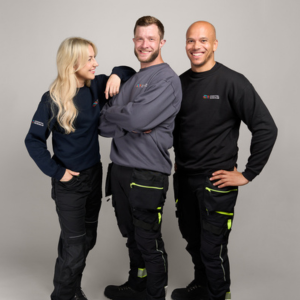
Workwear Replacement Frequency at a Glance
| Garment Type | Typical Replacement | Urgency | Primary Driver |
| Hi-vis vests and jackets | 6-12 months | Safety-critical | UV degrades fluorescent dyes below EN ISO 20471 |
| Flame-retardant/ arc flash | 12 months or wash-cycle limit | Safety-critical | FR treatment degrades invisibly with laundering |
| Healthcare tunics & scrubs | 6-12 months | Safety-critical | Infection control; high-temp wash degradation |
| Food industry whites / overalls | 6-12 months | Safety-critical | Hygiene regulations (BRC standards) |
| Corporate / hospitality uniforms | 12-18 months | Appearance-driven | Brand image and wear-and-tear |
| Trade trousers and jackets | 12-24 months | Standard cycle | Abrasion at stress points; fabric weight |
| Weatherproof outerwear | 18-36 months | Standard cycle | Loss of water repellency over time |
| Safety footwear (EN ISO 20345) | 12-24 months | Compliance-driven | Sole wear, toe-cap integrity, ankle support |
Work uniforms take a daily beating. Whether it’s a chef’s whites enduring industrial laundering, a construction worker’s hi-vis vest battling UV degradation, or a care worker’s tunic facing repeat disinfection cycles, every garment has a finite useful life. Yet many organisations hold on to uniforms far too long (creating real compliance and welfare risks).
At Essential Workwear, we have created this guide that consolidates manufacturer data, sector guidelines, and regulatory frameworks so you have the clearest possible picture of when it’s time to replace.
Why Is Workwear Replacement Important
A worn-out uniform is more than an appearance problem. Degraded workwear can:
- Fail to meet PPE at Work (Amendment) Regulations 2022 requirements, exposing employers to legal liability.
- Compromise the wearer’s protection, for example a faded hi-vis clothing can reduce a worker’s visibility to others on site, potentially falling below EN ISO 20471 standards.
- Raise hygiene concerns in healthcare settings, where worn or degraded uniforms may compromise infection control standards.
- Damage your brand image, particularly in customer-facing roles where staff appearance directly informs how customers perceive the business.
- Affect employee morale: Workers feel more confident and productive when their uniform is in good condition.
The workwear replacement cycle is therefore a cross-functional concern spanning procurement, health & safety, HR, and operations.
Industry-by-Industry Replacement Benchmarks
Replacement intervals vary enormously by sector. The table below consolidates recommended replacement windows based on manufacturer guidance, industry body standards, and regulatory frameworks.
| Industry/Role | Recommended Replacement Cycle | Primary Driver | Key Standard/Reference |
| Construction & Civil Engineering | Hi-vis: 6-12 months. General PPE workwear: 12-18 months | UV degradation of fluorescent dyes; abrasion | EN ISO 20471 (Class 2/3 Hi-Vis) |
| Healthcare & Social Care | 6-12 months (clinical) 12 months (non-clinical) | Infection control; laundering degradation | NHS Uniforms & Workwear Policy 2020 |
| Food Manufacturing & Catering | 6-12 months | Hygiene regulations | BRC Food Safety Standards |
| Hospitality & Front-of-House | 12-18 months | Appearance standards: wear & tear | Employer brand; sector guidelines |
| Warehousing & Logistics | Hi–vis: 6-12 months. Trousers/Jackets: 12-24 months | Reflective tape degradation; abrasion | EN ISO 20471; HSE Guidance |
| Engineering & Manufacturing | FR/arc flash garments: 12 months. General: 18-24 months | Flame-retardant treatment efficacy | EN ISO 11612; EN 61482-2 |
| Security & Facilities Management | 12-24 months | Professional appearance and durability | Employer policy |
| Agriculture & Outdoor Trades | 12-18 months | UV, chemical and abrasion exposure | HSE Agricultural guidance |
| Education & Childcare (staff) | 18-24 months | Appearance | Employer policy |
What Factors Affect How Long a Work Uniform Lasts?
No two workplaces are identical. The following factors will shorten or extend your workwear replacement cycle significantly.
1. Wash Frequency & Laundering Method
Industrial laundering at high temperatures (60°C+) which is common in healthcare and food production, can significantly reduce fabric tensile strength over repeated wash cycles. Home laundering at 40°C is gentler but may not meet hygiene requirements in clinical or food environments. Always follow the garment’s care label: exceeding recommended wash temperatures is one of the most common causes of premature uniform failure.
2. Duration & Intensity of Wear
A full-time operative wearing PPE overalls five days a week accumulates roughly 250 wear cycles per year. Part-time staff or seasonal workers can often extend their replacement cycle proportionally. Shift patterns, physical exertion levels, and exposure to harsh conditions (heat, chemicals, sharp edges) all accelerate fabric degradation.
3. Fabric Composition
| Fabric Type | Typical Lifespan (Full-Time Use) | Notes |
| 100% Cotton | 12-18 months | Comfortable but less durable with heavy washing |
| Poly-Cotton (65/35) | 18-24 months | Good balance of comfort and durability |
| 100% Polyester | 18-30 months | High durability |
| Ripstop/ Technical Fabrics | 24-36 months | Engineered for abrasion; higher initial cost |
| FR (Flame-Retardant) Treated | 12 months (or per test certificate) | Protection level must be re-verified |
4. Compliance & Certification Status
For PPE garments including hi-vis, FR clothing, chemical protective suits, and cut-resistant workwear, replacement is not purely about visible wear. The CE/UKCA mark confirms conformity at the point of manufacture, but that conformity does not last indefinitely. Employers have a legal duty under the Personal Protective Equipment at Work Regulations 2022 to ensure PPE remains effective. If a garment cannot be verified as still meeting its original certified standard, it must be retired regardless of its apparent condition.
5. Visible Damage & Inspection Failures
Any garment that fails a visual inspection should be removed and replaced immediately, irrespective of its age. Inspectors should look for:
- Tears, rips, or thinning fabric at stress points (knees, elbows, crotch seam)
- Faded or peeling reflective tape on hi-vis garments
- Permanent staining from chemicals, oils, or biological matter
- Broken zips, missing buttons, or damaged fastenings that compromise fit
- Pilling or bobbling that indicates significant fibre breakdown
- Loss of water repellency on weatherproof outer layers
6. Employee Growth, Role Changes & Turnover
Poorly fitting workwear is both a safety risk and a welfare concern. Uniforms should be replaced whenever an employee’s size changes significantly, or when a role change requires different PPE category. High staff turnover which common in hospitality, care, and logistics, means garments are often returned in varying conditions; a per-garment condition assessment on return is best practice.
Workwear Inspection Checklist: What to Check
Implement a scheduled inspection programme using the checklist below. Essential Workwear recommends conducting formal inspections at least every six months for safety-critical garments, and annually for general workwear.
Tip: Assign a named individual (line manager or H&S lead) to sign off inspections. A documented record protects your organisation in the event of a workplace incident or HSE audit.
| Inspection Point | Pass Criteria | Action if Failed |
| Fabric integrity | No tears, holes or thinning patches | Remove and replace |
| Colour/Reflectivity (hi-vis) | Fluorescent colour meets EN ISO 20471 standards | Remove and replace |
| Reflective tape | Tape securely bonded; no peeling or cracking | Remove and replace |
| Fastenings (zips, buttons, velcro) | Fully functional and closing correctly | Repair or replace |
| Fit | Fits correctly without restricting movement or creating trip hazard | Re-issue correct size |
| FR / chemical protection (if applicable) | Within manufacturer’s certified wash cycle limit | Replace and log |
| Hygiene / staining | No permanent staining; no biological or chemical residue | Replace; investigate laundering process |
| Branding / ID elements | Name badges, embroidery, and logos remain clear and intact | Re-embroider or replace depending on condition |
What Happens If You Don’t Replace Workwear Often Enough
Both under-replacement and over-replacement carry real costs. The table below compares the consequences.
| Replacing Too Infrequently | Replacing Too Frequently | |
| Safety Risk | High: Degraded PPE may fail in an incident | Low |
| Legal Exposure | High: Breach of PPE Regulations 2022 | None |
| Direct Cost | Lower short-term spend | Higher annual procurement budget |
| Hidden Cost | Enforcement action; compensation claims; reputational damage | Over-spend; excess stock waste; sustainability impact |
| Employee Morale | Negative: staff feel undervalued | Neutral to positive |
| Brand Impact | Negative: scruffy presentation | Positive |
How to Create a Workwear Replacement Policy
A documented policy removes ambiguity and protects both employer and employee. A robust policy should cover:
- Defined replacement intervals by role and garment type (use the tables in this guide as a starting point)
- Inspection frequency — who conducts it, how it is recorded, and who has authority to withdraw a garment
- Employee reporting obligations — staff must be encouraged (and feel safe) to report damage without fear of blame
- Laundering responsibilities — employer-provided laundry vs. home laundering, with clear temperature and cycle guidance
- Return and disposal procedures — particularly important for branded, security, or ID-bearing garments
- Budget review cadence — annual review aligned to procurement planning
Essential Workwear note: We offer account management support to help you build a replacement schedule tailored to your workforce size, sector, and budget, so you’re never caught out. Speak to our team to find out more.
Sustainability & the Workwear Lifecycle
Uniform replacement doesn’t have to mean waste. As part of a responsible workwear replacement cycle, businesses should consider:
- Garment collection schemes — several manufacturers, including us, now offer take-back programmes for recycling or reprocessing
- Longer-lasting fabric investment — spending more on higher-grade fabrics (ripstop, CORDURA® blends) often reduces total lifecycle cost and environmental impact
- Repair over replacement — for general workwear, a broken zip or detached pocket can be repaired rather than prompting a full replacement, extending garment life by months
The UK Textiles sector generates approximately 206,000 tonnes of clothing waste annually (WRAP, 2022). Thoughtful workwear lifecycle management is a meaningful way for businesses to reduce their contribution to that figure.
Quick-Reference Summary
| Garment Type | Minimum Review Interval | Likely Replacement Window |
| Hi-vis vests & jackets (EN ISO 20471) | 6 months | 6-12 months |
| Flame-retardant / arc flash clothing | 6 months or per wash log | 12 months |
| Healthcare tunics / scrubs | 6 months | 6-12 months |
| Food industry whites / overalls | 6 months | 6-12 months |
| Corporate / hospitality uniforms | 12 months | 12-18 months |
| Trade / workwear trousers & jackets | 12 months | 12-24 months |
| Weatherproof / waterproof outerwear | 12 months | 18-36 months |
| Safety footwear (EN ISO 20345) | 12 months | 12-24 months |
Frequently Asked Questions
How often should work uniforms be replaced?
Most work uniforms should be replaced every 6–24 months, depending on industry and role. Safety-critical garments such as hi-vis vests and flame-retardant clothing typically need replacing every 6–12 months, while corporate or hospitality uniforms can last 12–18 months. The exact interval depends on wash frequency, fabric type, and the conditions the garment is worn in.
Is there a legal requirement to replace PPE workwear?
Yes. Under the Personal Protective Equipment at Work (Amendment) Regulations 2022, employers have a legal duty to ensure PPE remains effective throughout its use. A CE or UKCA mark confirms conformity at the point of manufacture, but that conformity is not permanent. If a garment can no longer be verified as meeting its original certified standard, whether due to wear, laundering degradation, or age, it must be replaced, regardless of how it looks.
How often does hi-vis clothing need to be replaced?
Hi-vis garments should typically be replaced every 6–12 months. Fluorescent dyes degrade through UV exposure and industrial laundering, which can cause visibility to fall below the EN ISO 20471 standard even when the garment appears intact. Reflective tape should be inspected every six months; if it is peeling, cracking, or no longer bonded securely, the garment must be replaced immediately.
Does washing workwear more often mean it needs replacing sooner?
Yes, significantly. Industrial laundering at 60°C or above accelerates fabric degradation with every cycle. A garment washed five times per week accumulates wear far faster than one laundered once weekly. Always follow the care label; exceeding the recommended wash temperature is one of the most common causes of premature uniform failure. Flame-retardant garments must be replaced once they reach the manufacturer’s certified wash cycle limit, regardless of visible condition.
When should flame-retardant (FR) workwear be replaced?
Flame-retardant and arc flash garments should be replaced within 12 months or when the manufacturer’s specified wash cycle limit is reached, whichever comes first. The FR treatment can degrade without any visible signs of wear, so it is essential to maintain a wash log for each garment and retire it at the certified limit. Under EN ISO 11612 and EN 61482-2, protection levels must be verifiable; if they cannot be confirmed, the garment must be withdrawn.
How do I know if a uniform needs replacing before the scheduled interval?
Any garment that fails a visual inspection should be removed immediately, regardless of age. Key signs include: tears or thinning fabric at stress points; faded or peeling reflective tape; permanent staining from chemicals, oils, or biological matter; broken zips or fastenings that compromise fit; pilling that indicates significant fibre breakdown; and loss of water repellency on weatherproof layers. Essential Workwear recommends formal inspections at least every six months for safety-critical garments, and annually for general workwear.
Conclusion: Set Your Workwear Replacement Cycle with Confidence
There is no single universal answer to how often work uniforms should be replaced but there are clear, evidence-based parameters for every sector. The workwear replacement cycle is determined by a combination of regulatory requirements, fabric science, wear patterns, and practical inspection results.
The golden rules are straightforward: inspect regularly, replace safety-critical garments within manufacturer-certified limits, document everything, and never ask a member of staff to wear a garment that fails a condition check.
At Essential Workwear, we supply a comprehensive range of industry-specific workwear and PPE that’s built to last and we can help you establish a replacement programme that protects your people, meets your compliance obligations, and makes the most of your uniform budget.
Looking for more guidance on branded workwear?
If you’re ready to invest in branded uniforms for your team, we’ve put together a range of guides to help you make the right choices. Our average cost of branded workwear guide breaks down pricing by garment type and branding method so you can plan your budget, and our logo placement guide covers the best positions for your logo across different uniforms. For advice on the right number of sets per employee, see our guide to how many uniforms an employer should provide.
When you’re ready to get started, you can browse our full range of branded workwear and work uniforms, have a look at our current workwear deals and bundles, or request a corporate account for your team.